
If you run a small-to-medium business here in New Zealand, marketing can often feel like a moving target. Whether you’re an owner juggling growth alongside operations, or you have a sole sales and marketing manager working hard to keep up with the demands of the business, getting your plan right as we look towards 2027 comes down to focus.
One of the most practical concepts you can use to frame your strategy for 2027 is the 95/5 rule. It’s a grounded framework that changes how you view your buyers, how you set your budget, and how you approach lead generation versus brand building.
Here is how to apply it to your B2B marketing planning for the years ahead.
What is the 95/5 Rule?
The 95/5 rule comes from research conducted by Professor John Dawes of the Ehrenberg-Bass Institute, published in partnership with the LinkedIn B2B Institute.
His research highlights a fundamental reality of business-to-business sales: at any given point in time, only around 5% of your potential business clients are actively "in-market" for what you offer.
These are the buyers who have an urgent problem, an allocated budget, and are actively searching for a supplier right now.
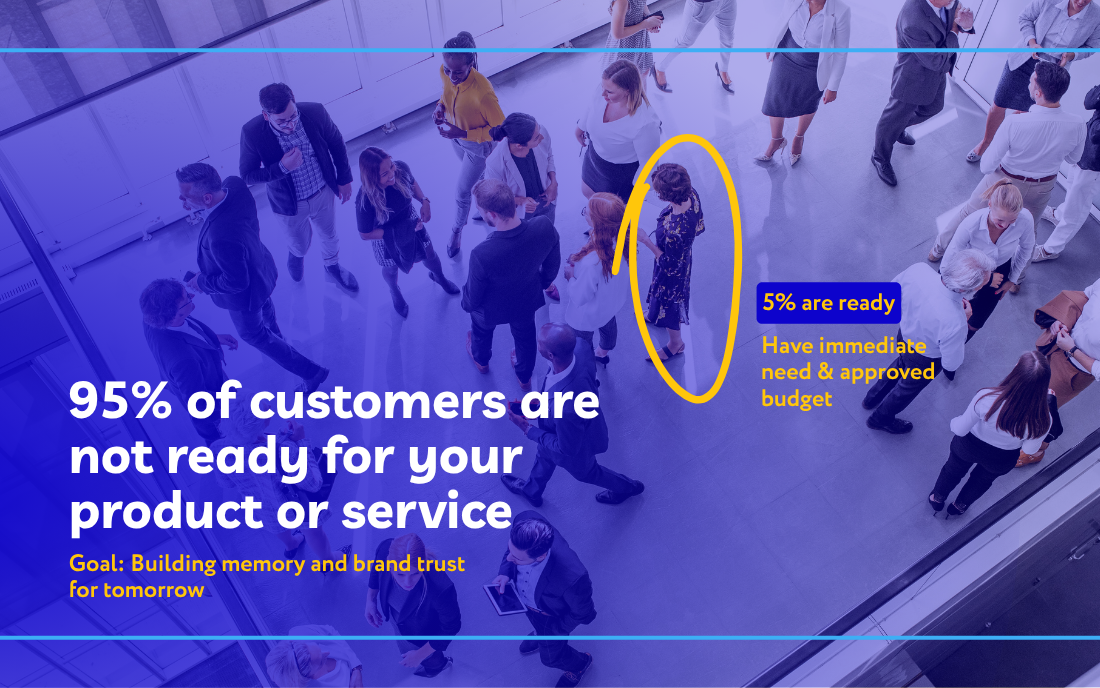
The other 95% are out-of-market. They aren't looking to switch providers. They might be tied into an existing contract, managing other priorities, or simply not in a position where they need your service today. Over time, that 95% gradually trickles into the 5% as their contracts expire, frustrations with current suppliers grow, or their needs shift.
The trap many NZ SMEs fall into is spending 100% of their B2B marketing budget fighting strictly over that 5%.
Because almost all of your direct competitors are running Google Ads, cold outreach, and direct sales messages aimed at the exact same active buyers, it becomes an expensive, noisy fight for attention. To build steady, predictable growth, your business needs a system that captures the 5% who are ready today, while ensuring you are the first brand the 95% think of when they become ready tomorrow.
Should you spend your budget on Brand or Performance marketing?
Understanding the 95/5 rule helps solve one of the biggest questions in B2B marketing planning: how should we split our budget between brand building and performance marketing?
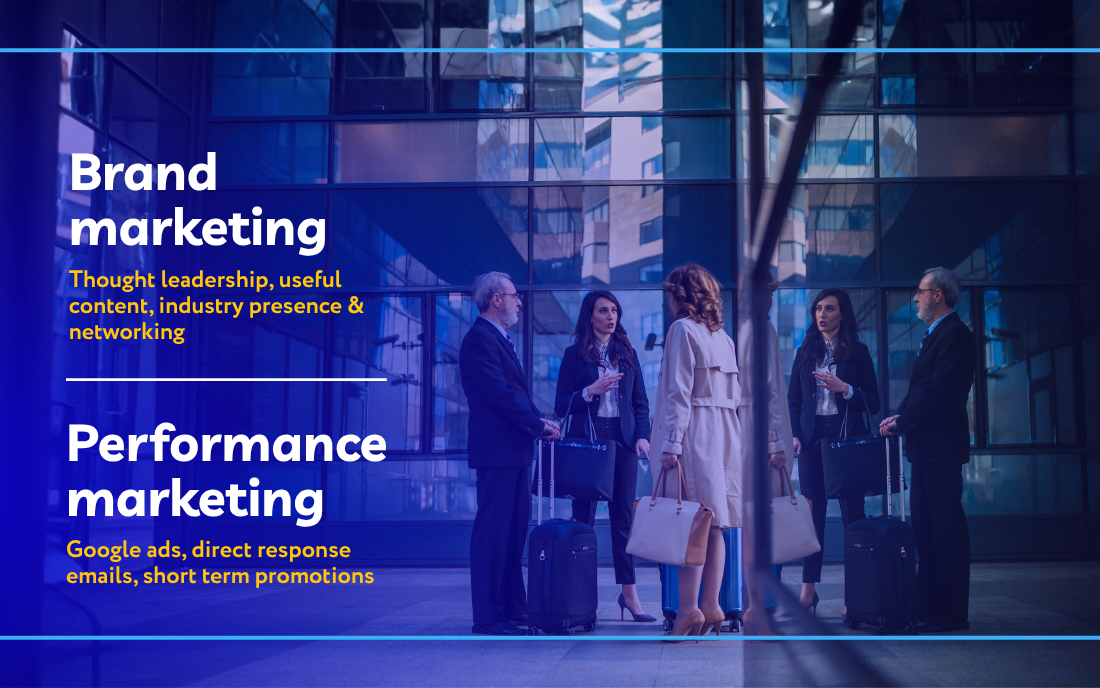
Performance marketing (Google Ads, direct response emails, short-term promotions) is designed to capture the 5% who are actively searching.
Brand building (thought leadership, industry presence, useful content, networking) is designed to stay visible to the 95% who aren't ready yet.
How you split these funds depends on where your business is currently at:
Early growth/ new product or service offering: needs immediate revenue, testing product/ market fit. These marketing plans may lean heavier into performance marketing
Established / scaling: cost per acquisition is rising, needs sustainable growth, changing customer perception. The marketing split may be 40% brand, 60% performance.
Note: There's no hard and fast rule and the split depends on each individual’s business context
Relying solely on performance marketing works well up to a point, but eventually, you run out of active buyers in a small market like New Zealand. Acquisition costs start creeping up.
Investing in brand building isn't about vanity metrics or awards. It builds familiarity, recall, and trust. When that 95% eventually moves into the buying window, they will already know who you are. This lowers your conversion costs significantly because your sales team doesn't have to start the conversation from scratch.
Rethinking B2B events as community builders
When it comes to building trust with the 95%, in-person connections remain one of the strongest channels for B2B marketing in NZ. However, "events" don't need to mean renting out a convention centre or spending tens of thousands of dollars on a trade display.
For a local SME, smaller events framed around community and shared learning work much better. Think of:
A quarterly breakfast seminar for 12–15 target customers.
A round-table lunch discussing a specific operational challenge in your sector.
An informal, structured after-work session with a guest speaker.
The goal is to create a comfortable space where potential clients get to know your expertise and meet your team without feeling like they are being pushed into a sales funnel.
Managing 'Self-Promoters'
A common complaint with hosting small B2B events is when attendees from other non-competing businesses show up purely to pitch their own services to your guests. To maintain control and keep the focus on providing value:
Curate the guest list directly: Send personal, direct invites to specific roles rather than publishing a generic sign-up link on social media.
Set a tight topic: Build the event around a specific educational problem
Establish clear ground rules: Frame the event in your RSVP page as an open discussion and problem-solving space with a strict "no pitching" policy.
Accelerating Growth Through Adjacent Partnerships
You don't have to bear the cost and effort of reaching the 95% entirely on your own. One of the most under-utilised strategies for growing SMEs is partnering with complementary, adjacent businesses.
Look for non-competing companies that serve the exact same client profile as you.
Example: If you offer commercial fit out and installation, a natural partner would be a commercial real estate agent or interior design studio. By partnering up, you can:
Co-host small events and split the venue/catering costs.
Produce joint guides or co-authored articles distributed to each other's client bases.
Refer clients back and forth with a high degree of warm trust
It expands your marketing reach while halving your costs and workload - a huge win if you have small marketing resource.
Setting Your Strategy for 2027
As you sit down to plan your approach for 2027, take a step back from the daily pressure of immediate lead counts. Recognize that 95% of the market simply isn't ready to buy today, and that is completely normal.
Focus on building a balanced, pragmatic system:
Keep your performance marketing sharp and targeted to capture the 5% who need you right now.
Direct a steady portion of your efforts into simple, high-trust brand building - through consistent content and effective storytelling, small community events, and smart business partnerships - to nurture the 95%.
When the time comes for those buyers to make a decision, you won't need to compete on price or pitch hard - you will already be the trusted option on their shortlist.
Would an extra pair of helping hands accelerate your growth in 2027? Let’s grab a coffee if you feel we are a good fit!
